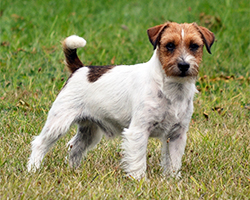
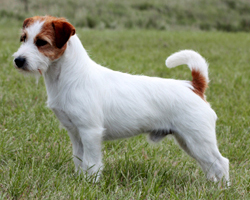
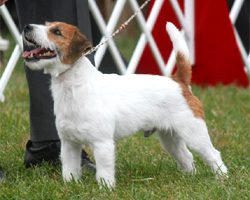
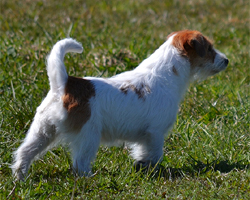
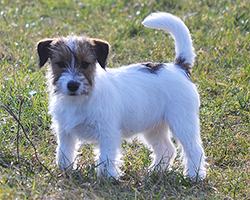
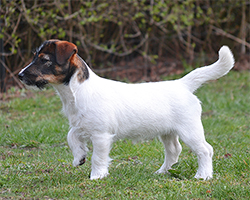
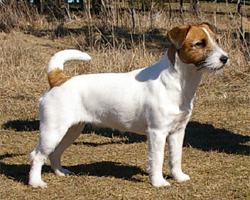
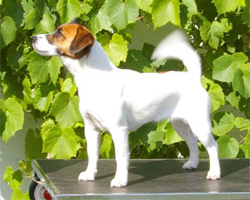
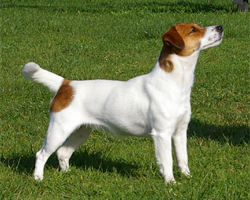
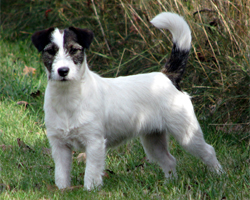
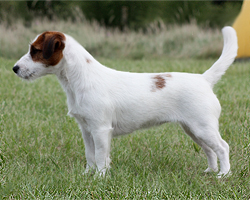
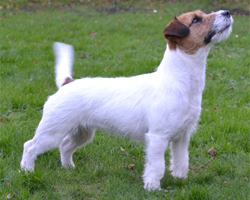
|
 Active,
alert and ambitious... Active,
alert and ambitious...
The Jack Russell
Terrier is a good working Terrier with ability
to go to ground, but also an excellent companion
dog.
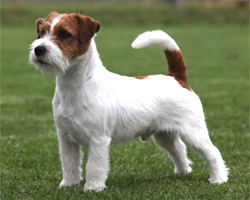
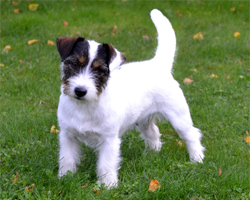
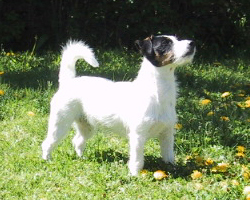
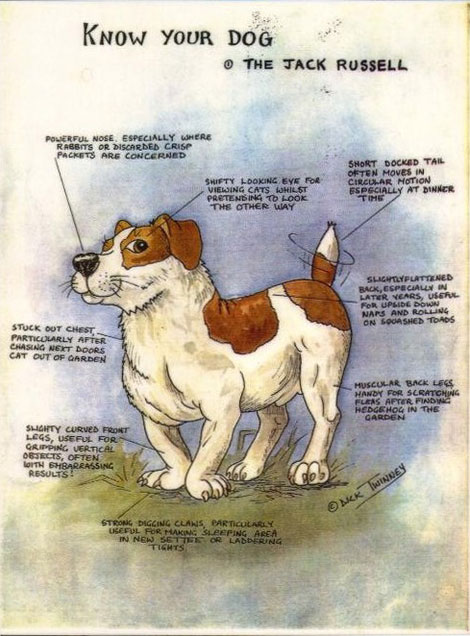
It is a lively, alert and active Terrier with a
keen, intelligent expression, bold and fearless,
friendly but quietly confident.
Spannability is the "Hallmark"
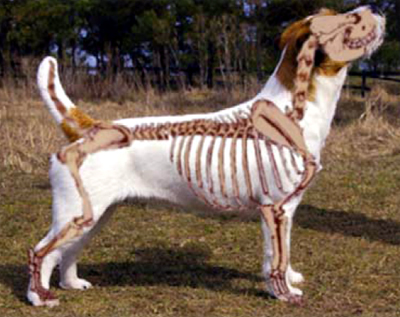
One of the most important attributes of a Jack Russell
Terrier is his spannable, flexible chest. He MUST be able to be spanned behind the shoulders by an average
man’s hands. Equally
important is the shape of his chest. The small, compressible, properly shaped chest allows him to
enter and move in the ground.
 Spanning guide by Liz McKinney Falling Branch Russell Terriers,
USA
Spanning guide by Liz McKinney Falling Branch Russell Terriers,
USA
The
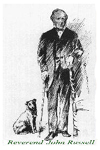
Story about the Jack Russell Terrier
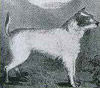
Jack Russell Terriers were first developed as a working
strain of the terrier in England during the 1800's, their
country of origin, by the Parson John (Jack) Russell.
Mr
Russell was educated at Blundell's School and Oxford
University and it was there, tradition has it, that he
spotted a little white
terrier bitch with dark tan spots over her eyes, ears and
at the tip of her tail,
who was owned by a milkman. Mr Russell bought the bitch on
the spot and this girl, called 'Trump',
became the foundation bitch of a line of fox hunting
terriers that would eventually come to be known as Jack
Russells.
The 'Parson' was a keen hunting man and throughout most of his adult life he
maintained a pack of hounds, and hunt terriers for the
sole purpose of pursuing the fox.
Russell's terriers were mostly what we today would call
broken coated, although they would occasionally throw a
smooth coat. They were longer on the leg too, as they were
expected to run with the hounds.
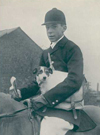 The terriers were not used to kill the fox, merely to
bolt, with their strong jaws often ripping out the
undergrowth, roots and earth. They were also used for hunting
rats and other rodents at the
farm. The terriers were not used to kill the fox, merely to
bolt, with their strong jaws often ripping out the
undergrowth, roots and earth. They were also used for hunting
rats and other rodents at the
farm.
The temperament had to be steady, as working and living in
a pack (and amongst Foxhounds) there was no room for
fighters or cringers.
The
terrain differed from Hunt Club to Hunt Club
and
dog packs within each terrain (i.e. within each Hunt Club)
became similar in type.
Especially widely separated Hunt Clubs, were also
too far apart to easily exchange genetic material. The conformation and type of the dogs
therefore differed markedly.
The smaller terriers did not run with the hounds, but were
carried in terrier pouches. It was impossible for them to
keep up with hounds running a scent at full speed through
the English countryside.
The English Foxhound is a tall, leggy dog that can run at
speeds, so that the horses are at a full gallop to keep
up. Imagine the futility of any earthworking terrier
trying to run with the hounds and horses.
Australia
It
is not really clear when the first Jack Russell Terriers
came to Australia, but the first imports came in 1964. Thus
the
early JRT imports was gifts and
may have come out as "breeding unknown", you can take it
for certain, that they were "bred in the purple".
For instance, in 1964, "Hardy" (JRI-5) was a gift from the
Duke of Beaufort (Beaufort Hunt Club in the UK) to
Australians Gold Medal winner of Olympic equestrian
fame Bill Roycroft and wife Mavis, as was "Kiss Me Kate" (JRI-6) from the Duchess
of Bedford (Bedford Hunt Club in the UK).
|
Thank you Sarah Gaffikin of
Brighthelm Jack Russells
for sharing this
information about the beginning of the Jack Russell
Terrier i Australia.
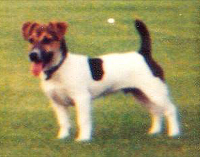
Louie of Brighthelm JRI-28
(1974-1988)
The early Jack Russells in Australia came from the UK, some
in the 60s, some in the 70s and 80s, there were dogs from Sussex and even from
the Heythrop Hunt! A Club was formed and a register started - so commenced a
pure bred Jack Russell. A breed standard (standard of perfection) was drawn up
and the natural progression was to hold shows. The breed standard incidentally
had a height range of 25cm- 34cms, reflecting that of the JRTCGB. You have to
realise that there was really no separate breed as a Parson in the 1970s, all
"Jacks" were registered together and bred together. What now occurred was a
slow but steady improvement in what we had, with breeders breeding to the
standard. Originally one annual show was held in Victoria and soon other states
followed.
The Jack Russell was still considered to be not pure bred, but of course we know
otherwise!
In Australia the National Kennel Council is made up of all states and
territories Kennel Councils - the Jack Russell Terrier Club of Australia - the
original and at that time the only Club for the breed, had been holding
discussions with the Victorian Canine Council for some time regarding recognition,
with no input from other states. I joined the NSW Canine Council, asked the
question, what did they think- was invited to a meeting, and following that was
invited to and spoke at the ANKC meeting that actually voted to recognise the
Jack Russell Terrier!
What people have to think about is - the Australian standard has always called
for a spannable dog, with a chest girth measurement, it has always asked for
brisket located at the height mid way between the ground and the withers (ie
equal body/equal leg) and there is also a weight requirement - maximum 6kgs.
These three points are considered to be hallmarks of the breed.
There are still organisations operating outside the ANKC bodies, the original
JRTCA, a Working Club or two.
Reputable ANKC breeders health test and have a strict code of ethics to adhere
to.
I brought three Jacks with me from England to Australia in 1981 - one from
Devon, one from Sussex and one we bred. I still have their direct lines today
and believe I am the breeder who has been breeding Jacks with the same
bloodlines for the longest time in Australia - closely involved with recognition
and I also co-wrote the application for the FCI to recognise the Jack Russell.
In a nutshell - the breed developed due to a breed standard, a really good
registration system, and some really good breeders. |

In
1972,
the Jack Russell Terrier Club of
Australia
was formed.
This national organisation set up a particularly
comprehensive registration system, along with a formal
breed standard. This club also initiated discussions with
the KCC regarding the possibility of the breed being
accepted for registration as a pure breed.
In 2000 the FCI (European div)
recognised the Jack Russell as a breed, with help from the
Irish Kennel Club and with a standard originating from
Australia.
So the country of origin is England and country of developement is Australia.
The Jack
Russell is classified as a small-sized Terrier.
What does the
"/JR" ending on some breeders prefix mean?
For a breed to be recognised in Australia it has to have recorded at least generations of
similar type, a documented pedigree of at least three generations.
The enormous job that the Jack Russell Club of Australia did
made it possible for the Jack Russell Terrier to become a recognised and
registered breed with the Australian National Canine Council (ANKC).
When
registering the prefixes "/JR" was added to the end of the prefix. The
breeders could then keep their prefix the same as they had with the Jack
Russell Club of Australia, without having any confusion with similar prefixes already registered with the ANKC. You could only breed Jack Russells under the
"/JR" prefix, unless it had been re-registered with the ANKC when
the prefix was available.
already registered with the ANKC. You could only breed Jack Russells under the
"/JR" prefix, unless it had been re-registered with the ANKC when
the prefix was available.
The "/JR" is a good indication that the breeder has been
breeding for a fair long time, but also some new breeders
like the sound of the "/JR" on the end and are adding it to
their prefix.
In that case they are not allowed to add the slash, but
only the JR.
Sweden
Sweden began to assess Jack Russell Terriers for registration in the Swedish Kennel Club in 2002.
The last assessment was at the SKC Show HUND2004. Further
assessments of the breed was not to happen. It was possible to get an exemption for an assessment when the dog
was one year old.
In 2008 this opportunity ceased and it will now only
be possible to get a special permission for registration
in the SKC.
In 2006 the Swedish breeding stock consisted of
assessed dogs together with imports mainly from Australia
and New Zealand, but also a few European dogs.
|